

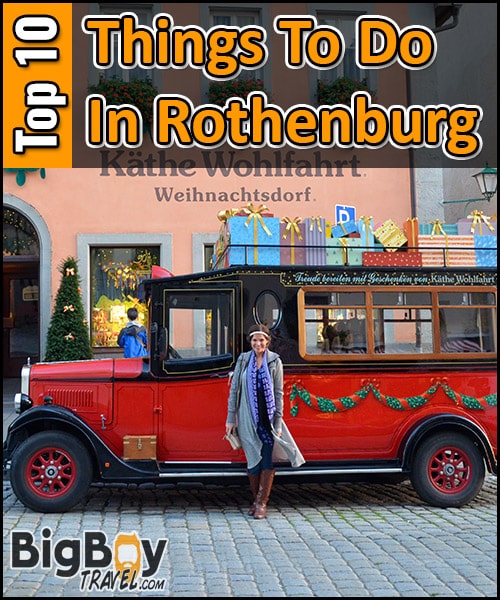
Top 10 Things To Do in Rothenburg:
Rothenburg, Germany, is one of our favorite towns in Europe because it is packed with so much Medieval beauty, fantastic attractions, and tons of festive events. With an abundance of options, narrowing down the top 10 things to do in Rothenburg was much tougher than we expected. The village may be small, but there is great diversity among Rothenburg’s best sights. The fact that Rothenburg is quite compact within its historic city walls is a huge advantage, as you can visit many of the best sights in as little as a day.
To get the full experience, you will really need to stay overnight, as Rothenburg becomes magical early in the morning and in the evening, after the hordes of tourists have left. There are a few of our favorite things to do in Rothenburg that don’t even start until after dinner time. For example, the Night Watchman Tour isn’t until 8 pm, and many of the festivals are way better after dark, so staying overnight is very important. We hope you fall in love with Rothenburg and its sights as much as we have!
A 400-Year Time Capsule: Walking into Rothenburg is like stepping directly into the Middle Ages. The pure, undeniable beauty of the Old Town is the main attraction, but when you mix in the legendary Night Watchman tour, world-class year-round shopping, and the surrounding fortress walls, you have the makings of an unforgettable visit.
Vetted Across Every Season: We haven’t just popped in for a quick afternoon; we’ve walked these exact streets in every season. From freezing our toes off at the magical winter Christmas Market to celebrating with local friends at the fall Imperial City Days festival—and even dragging our kids along for the ride—we know exactly what makes this town tick.
The Golden Rule: Our absolute biggest piece of advice? You must spend at least one night here. The city transforms and feels truly magical in the evening after the massive horde of day-tripper buses finally rolls out, leaving the lantern-lit streets almost entirely to you. Our route below is meticulously designed to hit all the heavy-hitting landmarks while using our firsthand experience to help you dodge those crushing midday crowds.
Related Article: Top 15 Hidden Gems In Rothenburg
Top 10 Things To Do In Rothenburg:
1. Stay Overnight In Rothenburg:
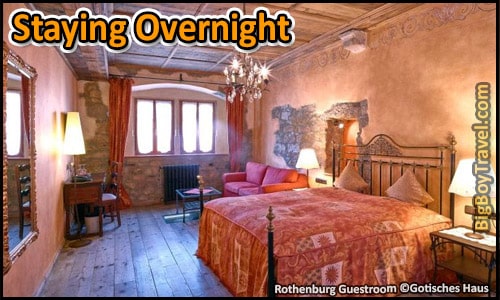
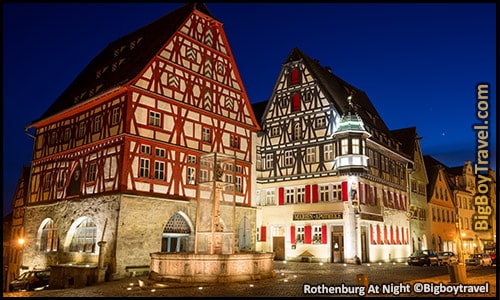
About Staying Overnight In Rothenburg: There are so many amazing things to do in Rothenburg, but at the very top of our list is simply staying overnight. Way too many tourists visit Rothenburg only for the day and miss out on the evening when the village is at its most magical. It just doesn’t quite feel like you have really visited Rothenburg until you have stayed here for at least one full night.
After the dinner bell rings, all the highly regimented tour bus groups are long gone from Rothenburg, and you feel like you have the entire village to yourself. Everything slows down, the hoards of tourists are gone, and you are able to experience the true beauty of the sleepy medieval Rothenburg. The street lamps glisten off the smooth cobblestones, the sweet air feels still, and you are clearly able to imagine what well-preserved Rothenburg was like 500 years ago.
Staying overnight in Rothenburg should be a priority as you plan your visit. We have a full list of our top hotels in Rothenburg, but our three favorites are the Gothic House Hotel, the Imperial Kitchen Master Hotel, and Hotel Eisenhut.
Read More: Top 10 Hotels In Rothenburg
2. Feel The Medieval Atmosphere:
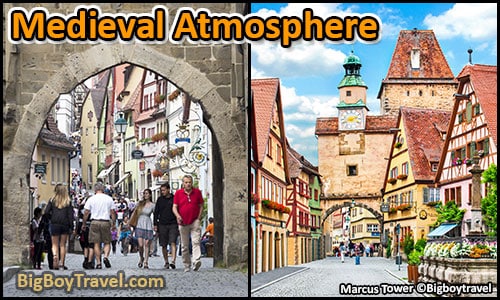
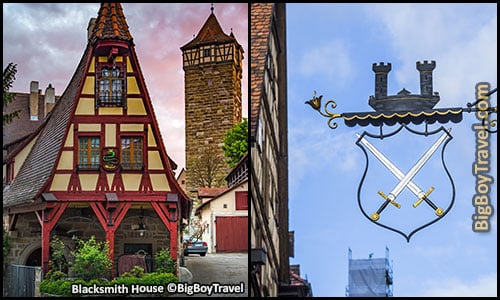
About The Medieval Atmosphere: The entire fairytale vibe of Rothenburg feeds off of its stunning medieval atmosphere, which enhances any activity you do during your visit. Many visitors say that Rothenburg feels like a real-life movie set, while others say it is like a life-sized snow globe; they are both correct.
With some homes dating back to the 900s, every inch of the village is jam-packed with colorful buildings from the Middle Ages and storybook half-timbered architecture. A huge Medieval city wall with watchtowers and gates circles Rothenburg and tries its best to contain the beauty of this well-preserved village, but it is no longer a secret. As you roam around the village, you’ll soon realize why Walt Disney fell in love with Rothenburg and used the picturesque setting as inspiration for some of his famous movies.
One of the coolest elements of the medieval atmosphere is the wrought iron signs that identify many of the buildings. These expressive signs were meant to serve as symbols of either the house’s name or the type of business, because in Medieval times, most people couldn’t read. From the Iron Hat Hotel to Mary’s Pharmacy, the Golden Greifen, and the Golden Sun, there are dozens of amazing medieval signs on every street in Rothenburg.
3. Attend A Festival In Rothenburg:
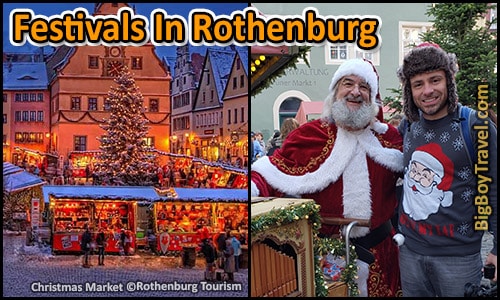
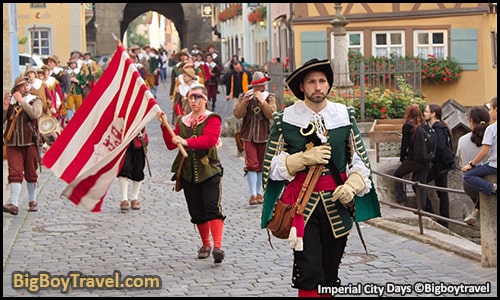
About Rothenburg’s Festivals: With over a dozen annual festivals, there always seems to be something great going on in Rothenburg. The beauty of the village is an attraction in itself, but during a festival, everything really comes to life. Usually held in Market Square (Marktplatz) and Green Market (Grüner Markt), the events range from historic reenactments to Medieval celebrations. Our favorite events are the Franconian Wine Festival, Imperial City Days (more info), the Master Draught, and, of course, the world-famous Rothenburg Christmas Market (more info).
Rothenburg’s Christmas Market (Reiterlesmarkt) is special for its perfect setting, and it has been held since the 1400s. At the time, Rothenburg was one of the Holy Roman Empire’s largest cities and on the crossroads of two major trade routes (Romantic Road & Castle Road), which brought in pilgrims and the best trade goods. Throw in the fact that Rothenburg was deeply religious, rich in textiles, had fertile land, plus great wine, and you have the makings of a great holiday celebration.
Today, the market still runs the entire Advent season and is one of the busiest times of the year. You will be able to sample authentic German food, warm mulled wine, called Glühwein (pronounced Glue-Vine), and shop for souvenirs, from nutcrackers to Christmas ornaments. One unique thing compared to other Medieval towns in Southern Germany was that it had the Krampus in December, whereas Central Germany had the Christmas Angel. Rothenburg, instead, has the Rothenburg Rider (Rothenburger Reiterle), who has become a beloved figure, and the market is named after.
The timeless Master Draught (Der Meistertrunk) festival, held over Pentecost (50 days after Easter), is one of the best Summer Festivals in Europe and has been celebrated since 1881. The festival takes you back to 1631, when Rothenburg was besieged by General Tilly of the Catholic League during the 30 Years’ War. This invasion is what locked the mighty Imperial City of Rothenburg frozen in time, and it is so much fun to visit. You get to see the village come to life as it is flooded with costumed reenactors preparing for battle, leading up to the Master Draught. Folklore says that in 1631, Mayor Nusch (Nu-sh) saved Protestant Rothenburg from destruction at the hands of the troops of Catholic General Tilly during the 30 Years’ War. The legend is that the famous mayor won a wager for Rothenburg’s fate by drinking over 3 liters of Franconian wine in one gulp, known as the Master Draught. The truth of the story is that General Tilly and his 40,000 troops occupied the village for the entire Winter before leaving, badly depleting Rothenburg of its food reserves.
Read More: Rothenburg Christmas Market
Also Read: Imperial City Days Festival
4. Take The Night Watchman Tour:

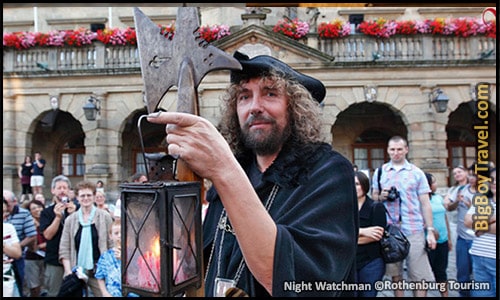
About The Night Watchman Tour: The Night Watchman Tour is by far the most memorable experience while visiting Rothenburg. Every night, a couple of dozen people meet in the Old Town Square to hear the Night Watchman’s tales about Medieval life in the village. Equipped with a lantern, a horn for alerting residents of trouble, and a battle ax called a halberd, you’ll stroll the old streets and dim alleyways together. The Night Watchman tours are quite humorous and very insightful.
In Medieval Rothenburg, there were 6 Night Watchmen patrolling different parts of town, lighting the street lamps, making sure the home’s doors were locked, and signaling for danger or fire. While the tours have been going on since 1990, the original Night Watchmen were still on duty until 1920. Make sure to stay overnight in Rothenburg for at least one night and take this tour. You’ll quickly see why the Night Watchman Tour is high on our list of the top ten things to do in Rothenburg!
If you are looking at other themed tours while in Rothenburg, there are a couple of extra options after you’ve done the Night Watchman. An excellent tour to consider is the Walburga Tour (website), where you are led around by a costumed widow of the 16th-century cobbler-master craftsman shortly after he passed away. Another overlooked tour is the eerie Executioner Tour (website), where you learn about the executioner’s duties and criminal punishments.
Tour Hours: 60 Minute Tours Daily at 8pm Mid-March Through December. Tour Cost: Adults 7€; Students 4€; Kids 12 & Under Free. Watchman Website: (HERE).
5. Do The City Wall Walking Tour:
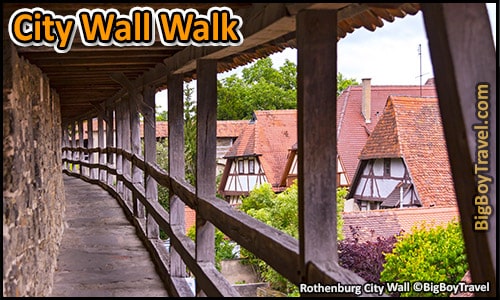
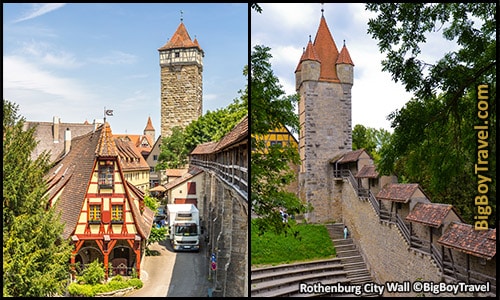
About The City Wall Walking Tour: Stretching 2.5 miles around Rothenburg and still guarded by 42 towers (out of the 70 original), the covered ramparts of the Medieval city wall are a true joy to walk. Not only is walking around the wall free of charge, but it is also open 24 hours a day, allowing you to walk portions of it at any time. Not only is the city wall one of the top things to do in Rothenburg, but for many, it is a lifelong bucket list item.
After King Conrad III built his castle in Rothenburg in 1142, the village naturally grew around it and soon required a protective wall. Starting with 4 major gates, the wall grew bolder by the century as Rothenburg became more prosperous. As King Conrad’s Castle fell into disrepair, its stones were used to expand the city wall, and mighty watchtowers were super-sized. Rothenburg became the 2nd-largest city in Germany in 1400, with 6,000 residents, and the wall grew with it. At its peak, the 70 watchtowers warned of danger, and the 20-foot-tall covered walkways provided shelter during sieges, allowing villagers to live safely off their stockpiles of food. Several breaches and occupations during the 30 Years’ War in the 1600s ultimately led to Rothenburg’s decline, and tourism didn’t recover for 200 years.
In World War 2, Allied bombings damaged 2,000 feet of the wall and 9 watchtowers, but the beauty of the village spared it from being leveled by artillery. Generous donations lead to the restoration of the wall, with people buying plaques to sponsor 1-meter sections of the ramparts. In 1950, each meter of sponsorship cost roughly $40; today, it is over $2,000. As you walk the wall, you can see the names of people from all over the world who have contributed to the preservation.
Read More: Rothenburg City Wall Walking Tour
6. Visit Plönlein Corner:
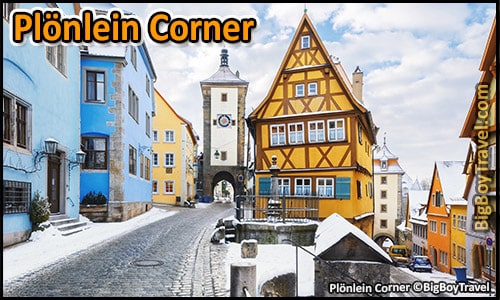
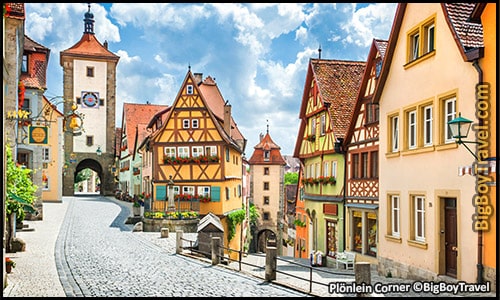
About Plönlein Corner: With colorful fairytale homes, the quaint Plönlein Corner is the most iconic image of Rothenburg. The square is centered on a bright yellow, half-timber home and a flowered water well. The picturesque corner is beautiful no matter the time of day or year. It’s no wonder that Plönlein Corner has been featured in numerous Walt Disney movies, including Pinocchio (1940) and Beauty and the Beast (2017). You will want to get here early in the day or toward the evening if you want a good photo at Plönlein Corner, as there are large groups of tourists here in the midday.
As the Smith Road reaches Plönlein Corner, the path splits into a low road and a high road, which leads you to either of the two gorgeous medieval watchtowers. The high road leads to the delightful Infirmary Quarter (Spital) and is protected by Sieve Makers’ Tower Gate, added in 1385. The lower road leads to the Tauber River Valley and has 4 gates making up the mighty Kobolzeller Tower.
Featured On: Rothenburg Old Town Walking Tour.
7. Visit Käthe Wohlfahrt’s Christmas Store:
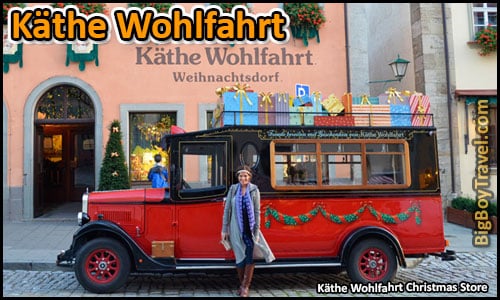
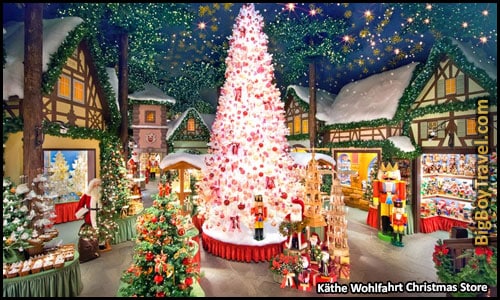
About Käthe Wohlfahrt: The delightful Advent Market has been held in Rothenburg since the 1400s, helping it become known as Christmas Town. Thanks to the famous Käthe Wohlfahrt Christmas Store, the holiday season now lasts all year long in Rothenburg. With 5 stores in Rothenburg and a global online presence, Käthe Wohlfahrt is world-renowned for the quality of its ornaments and Christmas wear.
The best location to visit is Käthe Wohlfahrt’s flagship store and headquarters right in the middle of town. It is easy to spot with the delivery truck out front, topped with oversized gifts. The multi-level store is a Christmas dream so vast that it houses Germany’s largest collection of ornaments. The interior is designed to feel like you are walking through a Christmas village, with houses serving as display cases and a painted starry-sky ceiling hanging above you.
The 2,700-square-foot German Christmas Museum (Deutsches Weihnachtsmuseum) sits above the main Käthe Wohlfahrt store and spans hundreds of years of holiday history. The interesting exhibits include everything from Christmas trees and ornaments to holiday pyramids, Krampus, Christmas cards, and more. This museum is one of the most honest Christmas museums we have ever been to, in how it ties Christmas traditions and Medieval folklore back to real-life history. Both the store and the museum at Käthe Wohlfahrt are among the top things to do in Rothenburg, Germany.
Käthe Wohlfahrt Website: (HERE). Christmas Museum Website: (HERE).
8. Tour The Medieval Crime Museum:
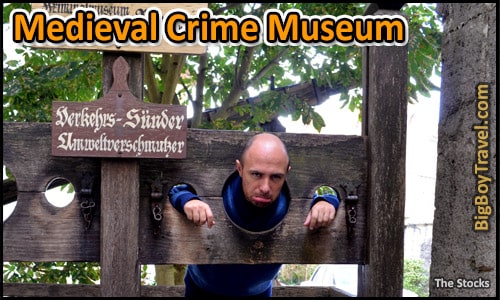
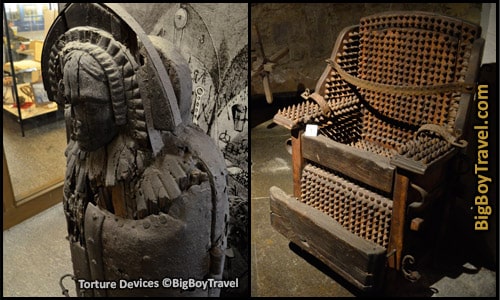
About The Medieval Crime Museum: The Medieval Crime Museum covers over 1000 years of Medieval legal history and some sensational criminal cases, including the persecution of witches and witchcraft in Bavaria. Housed in the seminary building of the former monastery complex of the Monks of Saint John, this is the only Medieval law museum in Europe! The fantastic self-guided tour of the museum covers 3 floors of exhibits, starting in the Medieval cellar of the former monastery.
Our favorite items at the Medieval Crime Museum are the instruments used for torture, shaming, and punishment. The torture devices were used for everything from stealing, to people who cheated on their spouses, and even those who gossiped too much. It is by far one of the coolest things to do in Rothenburg and helps get you into the Medieval spirit. If you plan to take the Executioner or Nightwatchman Tour, we really recommend visiting the Medieval Crime Museum first to get some extra history behind the stories you will learn.
Museum Website: (HERE).
9. Climb Town Hall Tower (Rathaustor):
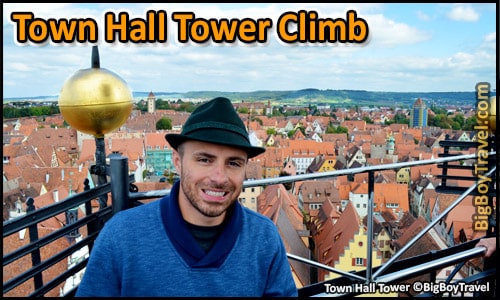
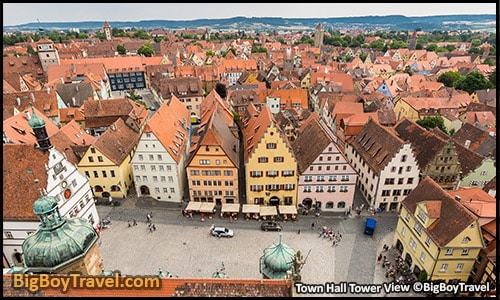
About Town Hall Tower: The large central tower at Rothenburg’s Town Hall has been a key part of the city’s defenses for centuries. The main purpose of the tower was to watch for fires and to provide a quick way to communicate with the city wall watchtowers that encircled Rothenburg. When the original Town Hall burned down in 1240, a double-fronted Gothic-style building was built here to replace it.
In 1501, the front half of the building facing Market Square burned and was replaced with the large yellow Renaissance section you see today. The white back half of the Town Hall was largely spared from the fire but received a slight Renaissance makeover and upgrade to its tower. The tower, which is accessed from Market Square, is 170 feet tall and has 222 zigzagging steps. The last stretch is a steep ladder leading to the outdoor observation galley. The views of the city, the surrounding Tauber River Valley, and the lively Market Square below you are amazing. With a bird’s eye view, you’ll quickly see how much of an advantage the tower was in the Middle Ages to the city’s defenses.
Town Hall Tower Hours: January-March & November Saturday & Sunday Noon-3pm; April-October Daily 9:30am-12:30pm & 1-5pm; During the Christmas Market 10:30am-2pm & 2-6pm (8pm Friday & Saturday).
10. Eat At To Hell Tavern (Zur Höll):
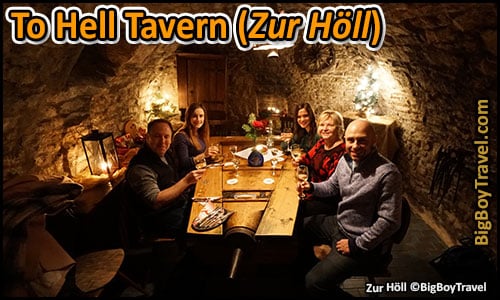
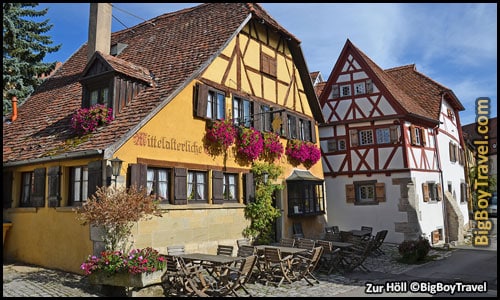
About Zur Höll: One of the best things to do in Rothenburg is to enjoy authentic German food while sipping local Franconian wine. Our favorite place to do this is the small To Hell Tavern (Zur Höll) on Castle Alley (Burggasse). It is housed inside the oldest home in Rothenburg with a foundation dating back to 970. The small, yellow, half-timbered cottage will bring you right back to the Middle Ages. While any table in the candlelit establishment is great, we really liked the one in the far-back cellar, with stone walls.
In the Middle Ages, this section of Castle Alley was part of Saint John’s Monastery, and the lane was covered with a wooden roof to shelter the monks from the public. Because the roof made the lane quickly dark, it earned the nickname “Hell,” which carried over to the restaurant when it opened. It is very rewarding to dine at the To Hell Tavern in the evening after the hordes of tourist buses have left Rothenburg.
Another popular medieval eatery is the Altfraenkische Weinstube (website), located near the Imperial City Museum. The decor is very cozy, and the food is great, but you will need to make reservations in advance. See our guide on the Best Restaurants In Rothenburg (more info).
Hell Tavern Hours: Summer Sunday-Thursday 10am-9pm; Friday & Saturday 10am-11pm. Christmas Market Daily 5pm-10pm. Winter Monday-Saturday 5pm-10pm; closed Sundays. Restaurant Reservation Requests: info@hoell.rothenburg.de. Restaurant Website: (HERE).
Related Video: Tour Of Zur Höll Restaurant
11. Stroll The Castle Garden (Burggarten):
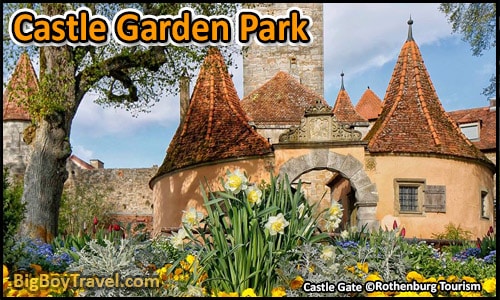
About Burggarten: Because of the cheap and fertile land in the Tauber River Valley, Conrad III, King of Germany, decided to build Castle Hohenstaufen here in 1142. The presence of the royal castle and the growing power of King Conrad led to the quick development of Rothenburg. Conrad had become the King of Italy in 1128, and in 1138 became the first member of the Hohenstaufen Dynasty to become the King of Germany, a title they would hold until 1254. With his conquests, King Conrad was on his way to becoming Holy Roman Emperor until his untimely death in 1152, although three members of his bloodline would claim the title.
Conrad’s quick rise to power and feud with Henry the Lion (founder of Munich in 1157) would mark the start of the Ghibellines versus Guelphs battles that would fester in the Middle Ages. Essentially, the Hohenstaufens were Ghibellines (Dukes of Swabia aligned with the Holy Roman Emperor), while the Dukes of Bavaria were Guelphs or Welfs (supporters of the Pope), and the feud famously spread to Tuscany in the 1200s.
After the death of King Conrad and the Duke who followed him, the castle in Rothenburg sat largely vacant from Royal visits, but the city continued to grow strong into a Free Imperial City by 1274. While debunked folklore claims the castle was ruined by the Earthquake of 1356, in reality, it fell into disrepair without royal attention until it was eventually sold to the village in 1380. By that time, Rothenburg had grown to be the 2nd-largest city in Germany, and the valuable stone from most of the run-down castle was then used to reinforce the wall and add new watchtowers. In 1400, Mayor Toppler decided to rebuild the castle’s Upper Ducal House into what is now the Chapel of St. Blaise. Originally, the castle didn’t have a chapel, and the Ducal House was actually where the king received his guests. Today, the chapel holds a memorial for WW1 & WW2, and inside and outside has a memorial for 250 Jewish residents of Rothenburg killed in 1258.
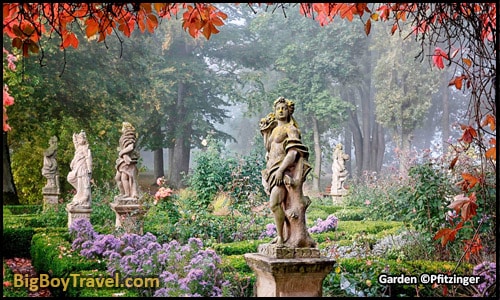
A majority of the former castle grounds were turned into today’s tree and flower-filled Castle Garden (Burggarten) Park in the 1700s. While the original castle did have a small produce garden, gardens and parks for leisure were not part of such complexes in the early Middle Ages. Rothenburg’s Castle Garden Park has beautiful geometric flower beds with 8 sandstone statues representing the 4 seasons and 4 elements. It is one of the best places in Rothenburg to relax, offering great views of the Infirmary Quarter to the South as well as both the town vineyards and Tauber River Valley below.
12. Explore The Imperial City Museum:
About The Rothenburg City Museum: In the early days, Rothenburg grew strong, was elevated to a Free Imperial City in 1274, and became the 2nd-largest city in Germany by 1400, with a population of 6,000. While the village was frozen in time during the Thirty Years’ War in 1631, you can learn about the most prosperous period of the city’s history at the Rothenburg City Museum.
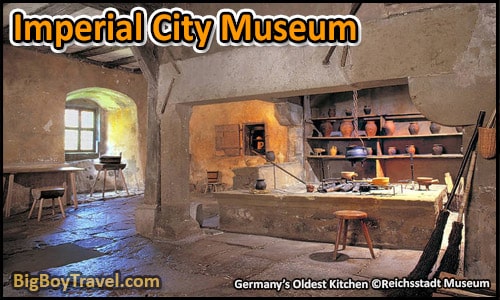
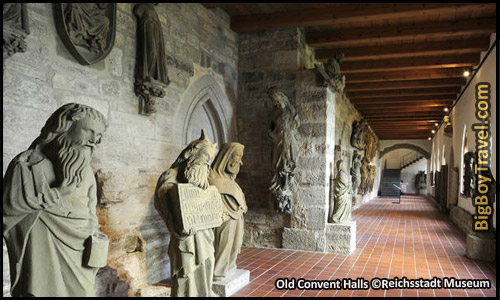
Opened in 1936, the museum is housed inside the dorms of Rothenburg’s former Dominican Convent. Many of the museum’s exhibits center on the Convent itself (founded in 1258 and dissolved in 1544), but it covers much more. Other sections include city history, medieval weapons, paintings, Jewish history, and the kitchen. The kitchen, dating back to the late 1200s, is considered Germany’s oldest kitchen. One of the coolest parts of the kitchen is the Lazy Susan that the nuns would use to give food to the poor outside the convent without being seen.
Museum Hours: April-October Daily 9:30am-5.30pm; November-March Daily 1-4pm. Museum Website: (HERE). Museum Cost: Adults 4.50€; Kids Free.
13. Tour Saint Jacob’s Church:
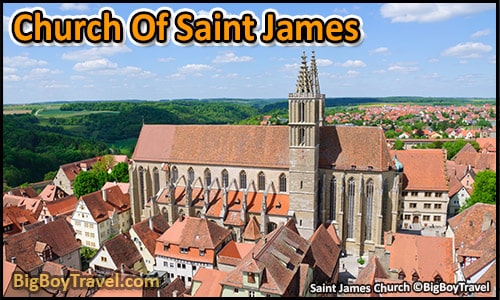
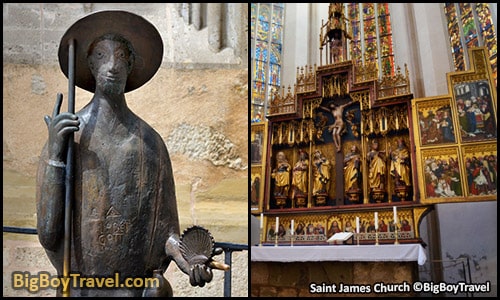
About The Church Of Saint James: The massive Church of Saint James (also called Saint Jacob’s) is the most important church in Rothenburg and was completed in 1485 after 170 years of construction. The church was dedicated to the Apostle Saint James, who was martyred by beheading in Jerusalem in 44AD. Saint James plays an important role in Rothenburg’s history, as it was here that 5 different segments of the Saint James Way pilgrim routes met in Medieval times on their way to his burial place in Spain. This crossroads of pilgrims’ routes brought goods, trade, and early tourism, helping Rothenburg grow into a rich city. You can find markers for the Saint James Way all over town, and we highlight them in our guide of the Top 15 Hidden Gems in Rothenburg.
The top attraction at the Church of Saint James is the wooden Altar of the Holy Blood, on display behind the 500-pipe organ. The multi-story wooden altar, carved by Tilman Riemenschneider from 1499 to 1505, is considered one of his best works. Equally as important, the Main Altar at the end of the central nave is the focal point of the church. This High Altar, carved in 1446, is dedicated to the Twelve Apostles and has the oldest representation of Rothenburg on its backside. We love the huge Medieval stained-glass windows, which let in amazing light against the nave’s light-colored interior and date back to 1350. The stained glass windows along the East choir are especially colorful in the morning sun.
Read More: Free Rothenburg Walking Tour
14. Imperial Kitchen Master Beer Garden:
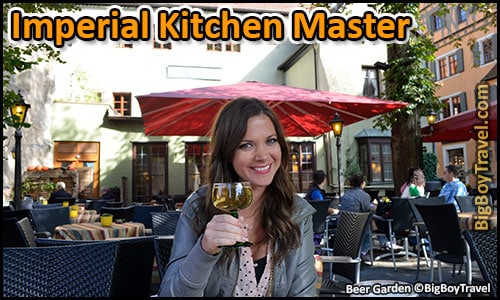
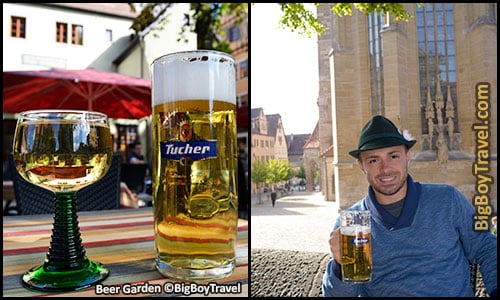
About The Imperial Kitchen Master: Whenever you visit a village in Bavaria, Franconia, or even greater Germany, one of the best things to do is to find a beer garden, and the Imperial Kitchen Master Restaurant has the best one in Rothenburg. The Imperial Kitchen Master’s beer garden patio is cozy and offers excellent views of the neighboring Saint Jacobs Church. We love the patio’s relaxing atmosphere and find it one of the best spots in Rothenburg to rest our feet while exploring the town. During the Christmas season, the outdoor area at the Imperial Kitchen Master gets transformed into a festive Glühwein Garden, which is a must-visit.
The restaurant itself is named after the former Imperial Kitchen Master, Lupold von Nordenberg, who built the mansion as a home in the 1200s. It was later turned into an inn in 1540 and hosted two different Holy Roman Emperors. Since being restored from WW2 damage, the Imperial Kitchen Master has operated as one of the best restaurants & hotels in Rothenburg and is an excellent place to sample Franconian foods.
15. Tauber River Valley & Vineyard:
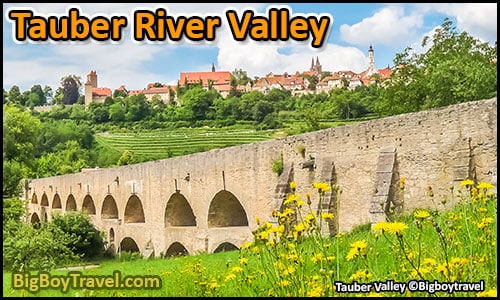
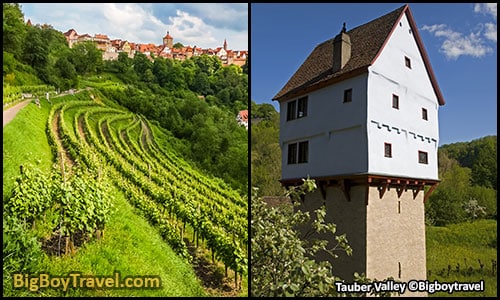
About The Tauber River Valley: Without the Tauber River Valley below Rothenburg, there would be no village, and it is very rewarding to visit. It all started with the establishment of a small parish just upriver in Detwang in 970, which led to the Counts of Comburg arriving in 1080 and to the future King of Germany, Conrad III, building his own royal castle here, sparking the growth of the village. As the village grew into a Free Imperial City in 1274, the Tauber River Valley supplied Rothenburg with an immediate source of water, fertile land for crops, great opportunities for milling, and transportation access all the way to the Main River in the North.
Today, there are still many great places to visit in the Tauber River Valley that most tourists miss out on. Within a very scenic 1.5-mile loop, you can see the massive Wildbad Manor Mansion (website), the old Gypsum Mill (Gipsmühle), the former Stone Mill (Steinmühle), the famous Double Bridge with excellent views of Rothenburg, the sprawling vineyard, and the top-heavy Toppler’s Water Palace (Wasserschlößchen) from 1388. There are numerous covered footbridges, and the entire route is paved, heading south out of the Infirmary Quarter, up along the Tauber River, and back into town on the Northside of Rothenburg’s Castle Garden Park. At a minimum, you should walk outside the city wall through the vineyard, but try to do the entire loop.
If you rent a bicycle to venture farther up the river, within a few miles, you can pass the grounds of the Taubertal Music Festival, get amazing views of Rothenburg from Reutsächser Steige, see the parish in Detwang from 970, and visit the old Celtic Wall (Keltenwall & Engelsburg). At the different sections of the Celtic Wall, you will see the remains of a settlement & buildings from the late Iron Age (2nd to the 1st century BC).
Honorable Mention:
16. Go Hot Air Ballooning:
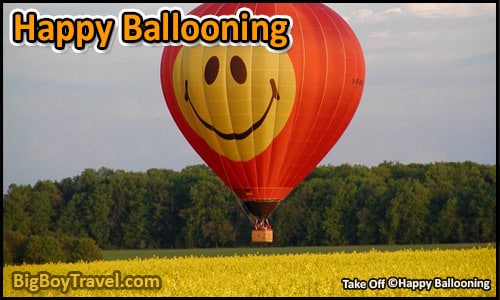
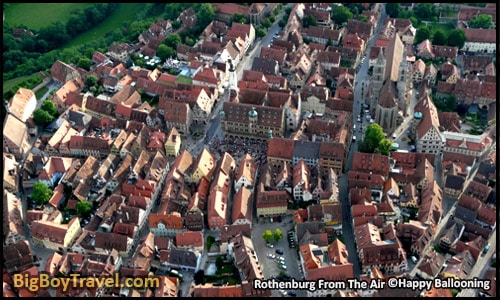
About Happy Hot Air Ballooning: For an entirely unique view of the Medieval village and Rothenburg’s countryside, take to the sky with Happy Hot Air Ballooning. Gliding in an open basket above the valley is about as Romantic as it gets. The company has it down to an art and schedules all its tours to align with either sunrise or sunset, so you get two experiences in one ride. The ride lasts around 90 minutes and can hold up to 5 guests. You really will feel like you are gliding as you are moving above the dew-filled grass with the wind instead of it blowing against you.
Happy Ballooning Hours: Balloons launch daily, April-October, at sunrise and again 2 hours before sunrise. They also have service in the winter, which depends more on weather conditions. The rides do not operate in heavy winds, rain, or fog. Happy Ballooning Website: (HERE).